
There are many books on Church History. One that is lauded is Diamand McCulloch’s “Christianity: The First Three Thousand Years.” It is a lengthy tome that will frighten most away at 1016 pages. To spare you a waste of time reading such behemoth of a book, I shall show you That MacCulloch’s bias appears early in the book, here is a escript from pg 24 that reads, “All Powerful Creator,”.. who dismissed Moses’ question “what is your name?” with a terrifying cosmic growl out of the burning bush in the desert, “I WILL BE WHO I WILL BE.” The Name of God of Israel is No Name.” (Diamand MacCulloch, Christianity: The First Three Thousand Years, Chapter One: A Millennium of Beginnings- Greece and Rome pg 24). Firstly, God did not growl at Moses when He gave his Name:
“Then Moses said to God, “If I come to the people of Israel and say to them, ‘The God of your fathers has sent me to you,’ and they ask me, ‘What is his name?’ what shall I say to them?” God said to Moses, “I AM WHO I AM.” And he said, “Say this to the people of Israel: ‘I AM has sent me to you.’” God also said to Moses, “Say this to the people of Israel: ‘The LORD, the God of your fathers, the God of Abraham, the God of Isaac, and the God of Jacob, has sent me to you.’ This is my name forever, and thus I am to be remembered throughout all generations.” (Exodus 3:13-15).
God actually gave Moses three names here for the Israelites: I AM That I AM which is Yahweh, Lord which is Jehovah or Yehovah and God of Abraham, Isaac, and Jacob. MacCulloch says God growled, there is no growl! MacCulloch says Israel’s God has no name, but here God gave three: Yahweh, Jehovah, and God of Abraham, Isaac, and Jacob.
It is clear in chapter one MacCulluch is twisting the facts, maligning who God is with his words and withholding information from the reader! For this reason he cannot be trusted. He is pseudo-historian who seeks to shipwreck people’s faith.

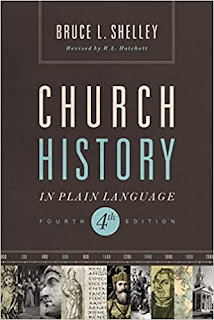
The Best alternative to MacCulloch’s false history book is Bruce Shelley’s “Church History in Plain Language 4th Edition”. It is a very captivating, engrossing, and easy to read book. Shelley’s prose keeps you hooked and wanting to read more, and it is only 540 pages, half of MacCulloch’s lengthy lie. Shelley’s book covers a broad timeline of Church History from 33 A.D. to 2000 A.D. It is the best overview volume that will give you a holistic account of church history.
Another good book is “Christian History Made Easy” by Timothy Paul Jones, PhD. It can also be purchased with videos and a study guide to lead a class or church group. This book is fully illustrated with artwork and pics to help aid in picturing times, events, people, and etc.

If you want a secular take on Church History, “A Brief History of Christianity” by Bamber Gascoigne. Its a good brief primer that actually explores some less known information like how the goddess Tammuz became Mary Guadalupe, and that secretly Latinos in Mexico village parishes keep their old gods inside Crucifixes and other saint images.

A worthy read for Church History from 100-325 A.D. is Eusebius’ “History of the Church.” It contains the letter of Jesus to the King of Edessa, the errors of Origen (Origen taught lies, beware of his heresy in the book), the persecutions of the Church during the Emperors of Roma, and the Rise of Constantine The Great and him claiming Christianity for the empire.

All of these volumes I recommend I have read. They are useful if you want tools to understanding how we ended up with so many denominations and schisms. They document Christ’s Church, and the many adventures and misadventures.
I recommend you start with Bruce Shelley or Timothy Paul Jones to get an overview and holistic account of the church throughout history, while using the other volumes to explore certain periods in more depth. Amen.
Comments
Post a Comment